
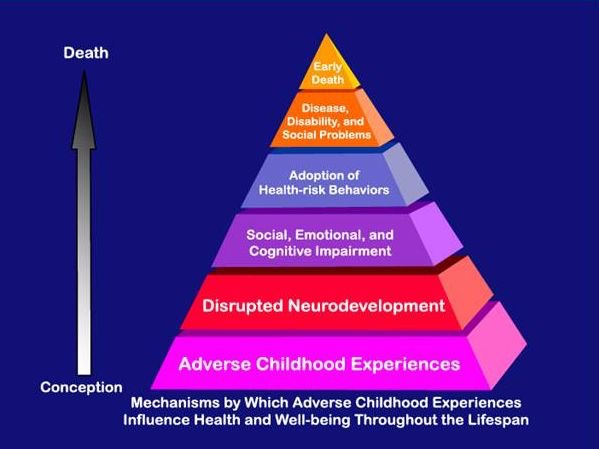
 The ACE study is a collaborative effort between the CDC and Kaiser Permanente to assess the impact of unresolved childhood trauma on a person’s long term physical and mental health, social functioning and mortality pattern. Per the CDC, ACE stands for Adverse Childhood Experience (from 0-18 years of age) from the following domains:
Abuse
• Emotional Abuse
• Physical Abuse
• Sexual Abuse
Neglect
• Emotional Neglect
• Physical Neglect
Household Dysfunction
• Mother Treated Violently
• Household Substance Abuse
• Household Mental Illness
• Parental Separation or Divorce
• Incarcerated Household Member
Referring back to our original definition of trauma – an experience that overwhelms a person’s ability to cope – the ACE premise is that risk for future biopsychosocial impairments increases in relation to the number of ACEs experienced during childhood. Exposure to trauma (acute, chronic and/or complex), and the consequent stress response that is triggered, can impact the long term health of the brain and other vital organs if these responses are not addressed and mitigated. Likewise, social impairment across a variety of domains is also a risk factor, as unresolved trauma may impact a person’s ability to achieve and sustain healthy social relationships, secure and maintain a job and have the necessary energy and focus to fulfill academic requirements. Left unresolved, childhood trauma can and does impact people until the time of their death. Consequently, early intervention can serve to forestall more profound downstream effects of trauma.
Through this longitudinal study of 17,000 participants, the CDC and Kaiser identified these potential risk factors in people’s future biopsychosocial behavior in correlation to the number of ACEs identified in childhood:
• Alcoholism and alcohol abuse
• Chronic obstructive pulmonary disease (COPD)
• Depression
• Fetal death
• Health-related quality of life
• Illicit drug use
• Ischemic heart disease (IHD)
• Liver disease
• Risk for intimate partner violence
• Multiple sexual partners
• Sexually transmitted diseases (STDs)
• Smoking
• Suicide attempts
• Unintended pregnancies
• Early initiation of smoking
• Early initiation of sexual activity
• Adolescent pregnancy
Left unresolved – through physical and mental health intervention – trauma response turns inward, affecting a person’s functioning and coping skills across a wide range of domains. Likewise, the impact can then become multi-generational.
For Interpreters: in-language resources are on the Download tab of the acestudy.org website listed below.
http://www.cdc.gov/violenceprevention/acestudy/index.html
http://www.acestudy.org/home
 Through My Mind's Eye