
As service providers working with people who are actively experiencing domestic violence, one might wonder “why don’t you just leave?” or “I would never put up with that.” Two judgments made too quickly…
The psychological, emotional, physical, familial and/or economic impact have such a stronghold on the client that s/he cannot imagine life without the perpetrator OR does imagine another way but does not know how to make that glimmer of hope a reality. Denial, minimization, self-blame, self-doubt, fear, shame, hopelessness, powerlessness…a few observations of clients actively experiencing domestic violence.
Domestic violence is cyclical in nature, following a pattern of:
- Honeymoon
- Calm
- Tension Building
- Explosion
Left uninterrupted, this cycle repeats over time, becoming more frequent and potentially more violent. The victim is left walking on eggshells, not sure when the next explosion might occur, working hard to minimize potential triggers, oftentimes to no avail. The honeymoon is seductive, giving the victim a glimpse of the good and the hope that it might last. It does not.
The tension building and explosion are not brought on by the victim, despite claims to the contrary (if you just did/didn’t say or do that I wouldn’t say/do this – translation: it is your fault). The perpetrator is adept at making this case, leaving the victim believing that s/he did, in fact, bring on the violence. If the victim brought it on then there is something that is within her/his power to restore harmony. Unfortunately, this is not true and, the more the victim tries, the less satisfactory the result. It is literally and figuratively a vicious cycle.
The interpersonal dynamic in these types of relationships involves subtle and not-so-subtle threats that compromise the victim’s sense of self, eroding it to a point where powerlessness prevails. Over time, the victim’s world shrinks, isolating her/him from others, fostering denial, fear and shame.
The image below represents The Duluth Model of Power and Control, a widely recognized model that defines the perpetrator’s intended goal – power and control over the victim – and examples of how this is achieved. As clients are familiarized with the breakout sections of the wheel, you will likely hear/see recognition on their part of some or all of these experiences.
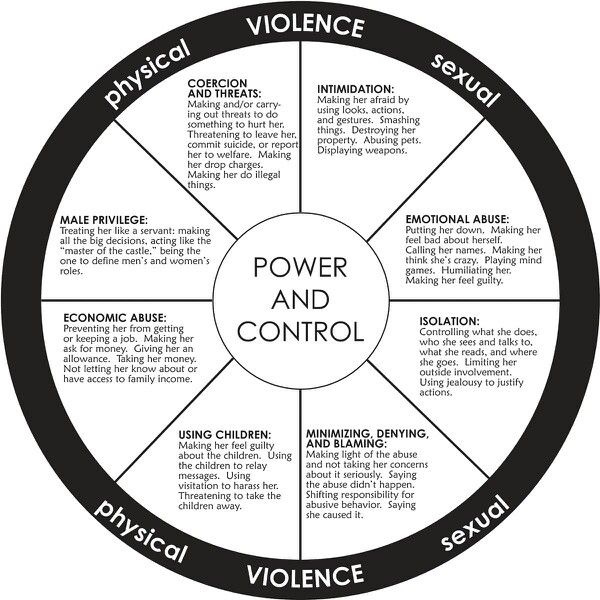
theduluthmodel.org
Violence is the means. Power and Control are the goal.
 Through My Mind's Eye